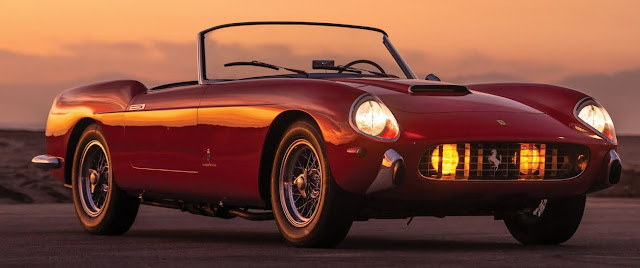
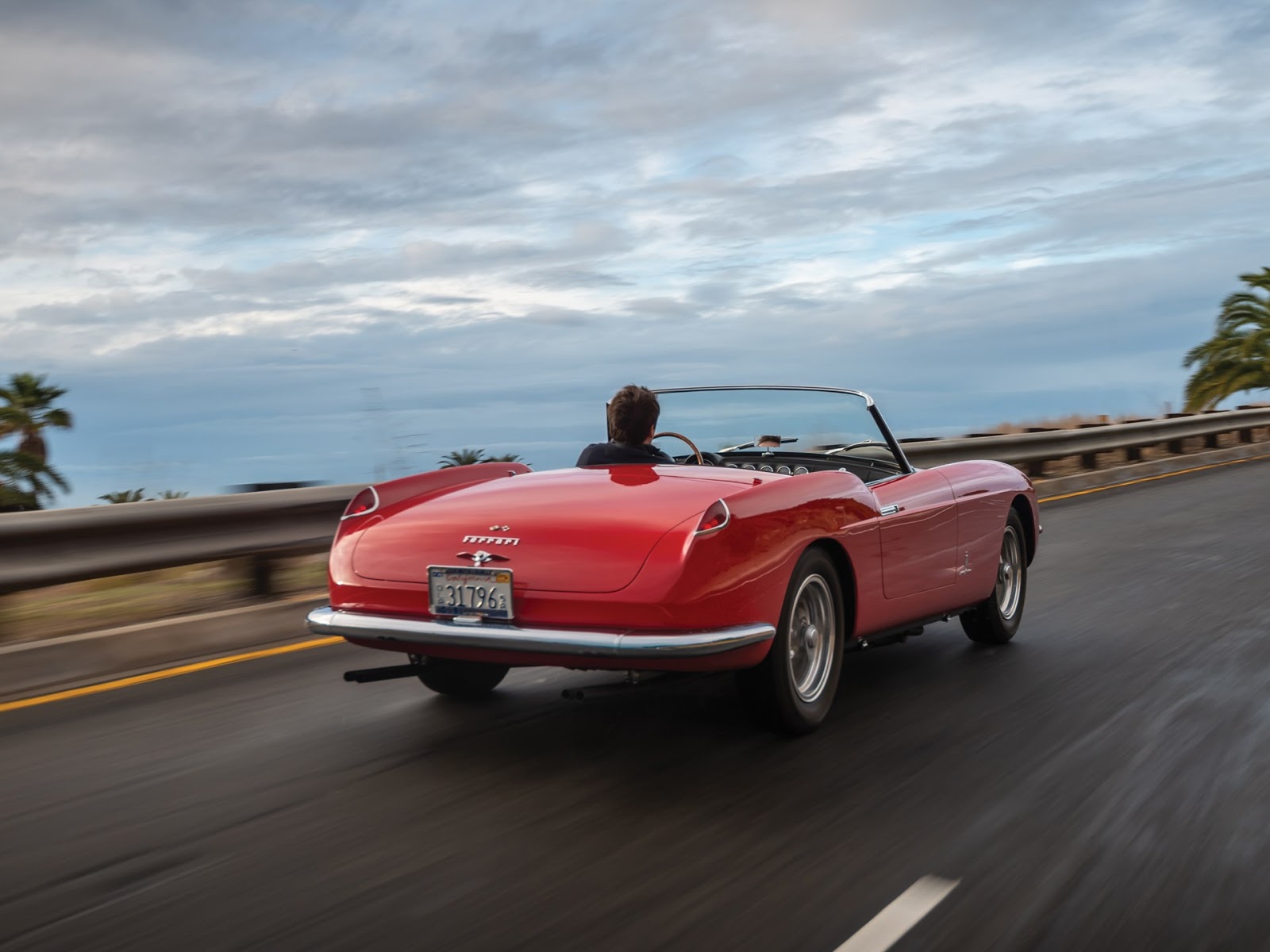
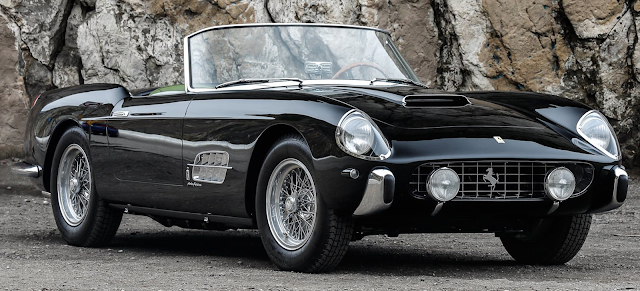
In March 1956 the coachbuilder Boano introduced a new open Ferrari built on the 250 GT platform. One year later Pinin Farina unveiled a more refined version. Pinin Farina used its initial design as the basis for a more formal series of luxurious cabriolets that featured wind-up windows and Borrani wire wheels. The coachwork remained unchanged through the production of 37 examples, though the last few were built with uncovered headlamps.
A total of 40 examples were built with 3 prototypes. Chassis no. 0913 GT is the 25th example built. While the bodywork was the same the interior details and trim were customized to order, and it is believed that no two were ever produced exactly alike.
Exquisite in build quality and very rare, the first-series Pinin Farina cabriolets were built through 1959. These cars rarely change hands and are usually held long term by their owners for their collections. Very few ever become available through public sale.
Immaculately maintained this example is what dreams are made of. The car high bid to $5.5m on January 17, 2020. Estimate was $6m to $7m.
Chassis number 0789 GT features some bespoke appointments like side vents, short “bumperettes,” and covered headlights.
During its heyday, it was the most expensive Ferrari at $14,950. 0789 GTmade $6.8m in 2019.
Auburn was a brand name of American automobiles produced from 1900 through 1937. In 1926 Auburn partnered with Duesenberg Corporation, famous for its racing cars, and used it as the launching platform for a line of high-priced luxury vehicles, the Duesenberg Model J. In 1937, production of Auburns, along with that of Cords and Duesenbergs, ended.
The Auburn Speedster (1935–37), and the Cord 810/812 (1936–37) became famous for their advanced engineering as well as their striking appearance. The Auburn Boattail Speedster was powered by a 4.6L straight eight that, with the popular supercharger option (150 hp), could top 100 mph (160 km/h). The Depression, coupled with Cord's stock manipulations, spelled the end of the company and production ceased in 1937.
Boattail Auburns are some of the most beautiful cars ever made, but they were some of the fastest as well.
At a time when Cadillac was competing directly with Rolls-Royce and its most powerful engine managed 90 horses, the Auburn put out 115 and topped 100mph.
$725,000 - $875,000
851 Boattail Speedsters were made and today reproductions are very popular.
709 miles.
Equipped with nearly $90,000 in factory options.
3.5L EcoBoost twin-turbocharged V-6 engine.
7-speed dual-clutch automatic transmission.
Mid-engined layout with a carbon fiber monocoque chassis.
Liquid Red Tri-Coat exterior protected with PPL on most panels.
Frozen White overtop stripes, $10,000 option.
Matte Exterior Carbon Fiber Package, $15,000 option.
Dark Energy Interior Upgrade Package, $30,000 option.
Interior features Alcantara and exposed carbon fiber details with race-inspired controls.
Leather-wrapped steering wheel, $250 option.
Pushrod suspension.
Active aerodynamics including an active rear wing.
CSX3355. 1 of 260 street 427 Cobra Roadsters produced. 427 CI side oiler V-8 engine.
4-speed manual transmission.
Bucket seats.
Knock-off wheels.
Billed to Shelby American on December 14, 1966. In 1966 Shelby took the new Mark III chassis and added the 510hp 427 V8 engine. He built 260 to be sold on the street car market, 31 S/C models, and 19 competition cars.
Ford's legendary “side-oiler” 427 cubic inch V8, was rated at around 485 horsepower in S/C specification (considerably more than the 425-hp street versions). Period tests recorded a top speed of 185 mph and 0–100–0 mph in just over 13 seconds.
The Shelby 427 Cobra is one of the most iconic symbols of American sports cars. The most replicated car in history, this original won't be given away. At Mecum.
The 1970 Plymouth AAR 'Cuda is a one-year-only homologation special designed for the SCCA Trans-Am racing series, with 2,724 units produced. It features a 340 cubic inch "Six-Barrel" V8 (290 hp), matte black fiberglass hood with functional scoop, strobe stripes, and side-exit exhaust.
Original matching numbers 340/290 HP 6-BBL V-8 engine. Trio of 2-barrel carburetors.
Air cleaner autographed by Dan Gurney and Richard Petty.
Factory side exhaust.
Factory A727 TorqueFlite 3-speed automatic transmission.
8 3/4-inch rear axle.
A-arm torsion bar front suspension.
Leaf spring rear suspension.
Front and rear sway bars.
Power brakes with front discs.
Matte Black fiberglass fresh air hood with functional scoop.
Finished in High Impact FY1 Lemon Twist with a black vinyl top and AAR graphics. Hagerty suggests a top example is trending around $125k. Here.
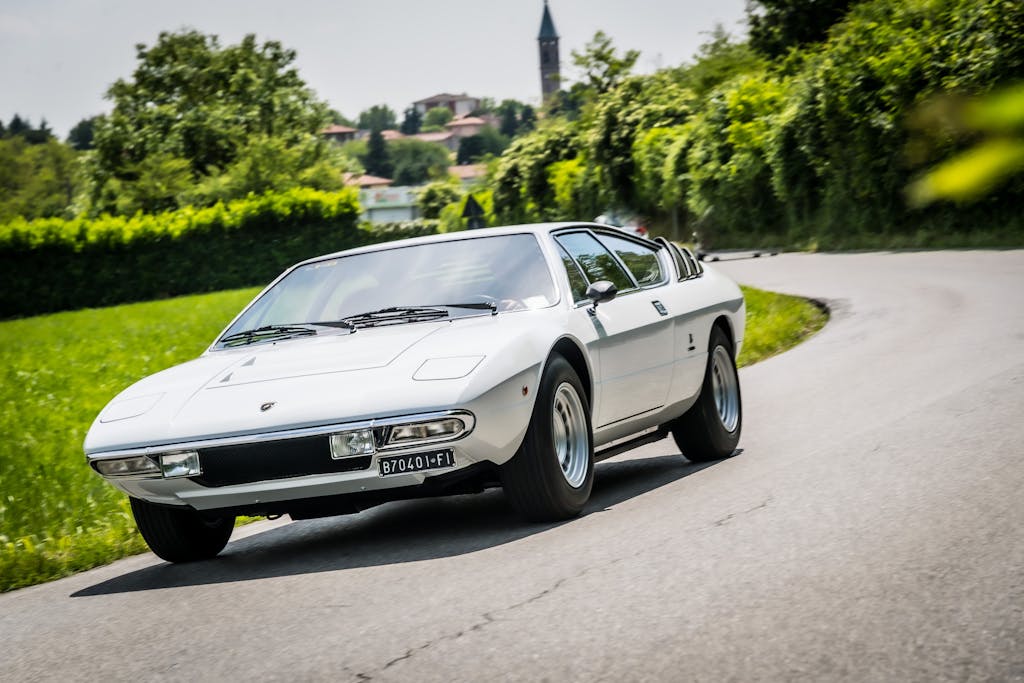
1973–77 Lamborghini Urraco. The follow-up to the Miura, it arrived for 1973. When the car arrived in the U.S. a year later, power was severely choked by emissions equipment, down to 180 hp. Not many were built, just 522 of the P250s and 205 P300s. A #3 (good) example ranges from $49,000 for a P250 to $59,000 for the P300. Cheap by Lambo standards.
1977–82 Porsche 924. With just enough power (110 hp from ’77 on) from a 2.0-liter four to complement its finely poised chassis, the 924 remains an excellent driver’s car. Rust killed many of them. Porsche built around 150,000 examples and parts are available although pricey. A good #3 example will cost about $8,500.
1980–87 Ferrari Mondial. The Mondial debuted in 1980 as a 2+2 coupe. The GT4’s 2927-cc transversely mounted V-8, with Bosch fuel injection replacing Weber carbs, made 214 hp. Nobody ever accused them of being fast. Long panned by Ferrarista, a #3 Mondial 8 or 3.2 coupe costs about $22,000, a pittance in Ferrari world.
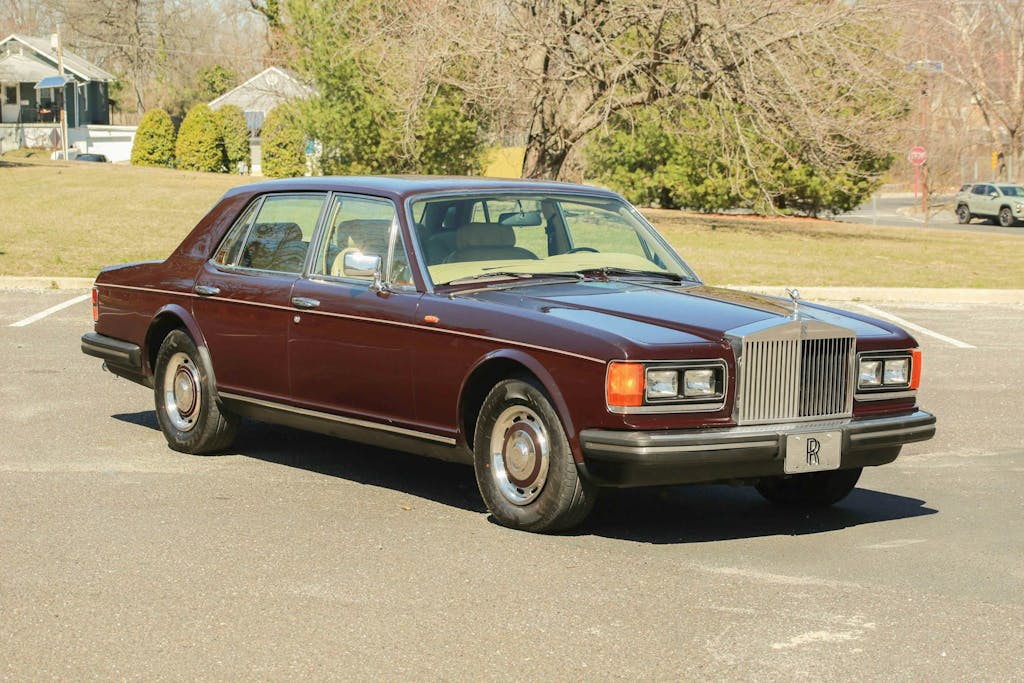
1981–87 Rolls-Royce Silver Spirit. Successor to the Silver Shadow, the Spirit utilized a 220-hp 6.75-liter V-8 mated to a three-speed automatic. Inside one gets all the trimmings. Rolls-Royces from this era are grossly expensive to maintain, and deferred maintenance claimed many of them. The right one, in #3 condition, is a reasonable $8,400.
1997–99 Aston Martin DB7. The 335-hp Aston DB7. With more than 7,000 produced in both coupe and convertible form, one gets is a grand tourer with excellent performance and a luxurious interior. Right now a 'good' example is around $21k, with the convertibles slightly cheaper.
The first series of the Miura are known as P400, followed by the P400 S and finally, the “SV.” The fundamental formula remained with a mid-mounted 3.9-liter all-alloy DOHC V12 with five-speed transaxle. The SV benefited from years of refinement and an increase in horsepower to 385. 150 SVs would be made.
Miura SV chassis number 4976 is one of the rare and most desirable late production split-sump, U.S.-market specification models. 4976 was completed to Miura SV specifications at the Sant'Agata Lamborghini works during fall/winter 1971/72. Destined for the U.S. market, the SV was finished in Argento Indianapolis Metallizzato (Silver Metallic) exterior color—a color in which just thirteen Miura SVs were painted from new.